Warm From the Dryer
A Monday evening at a neighborhood laundromat, and a brief offer of help with a sheet.
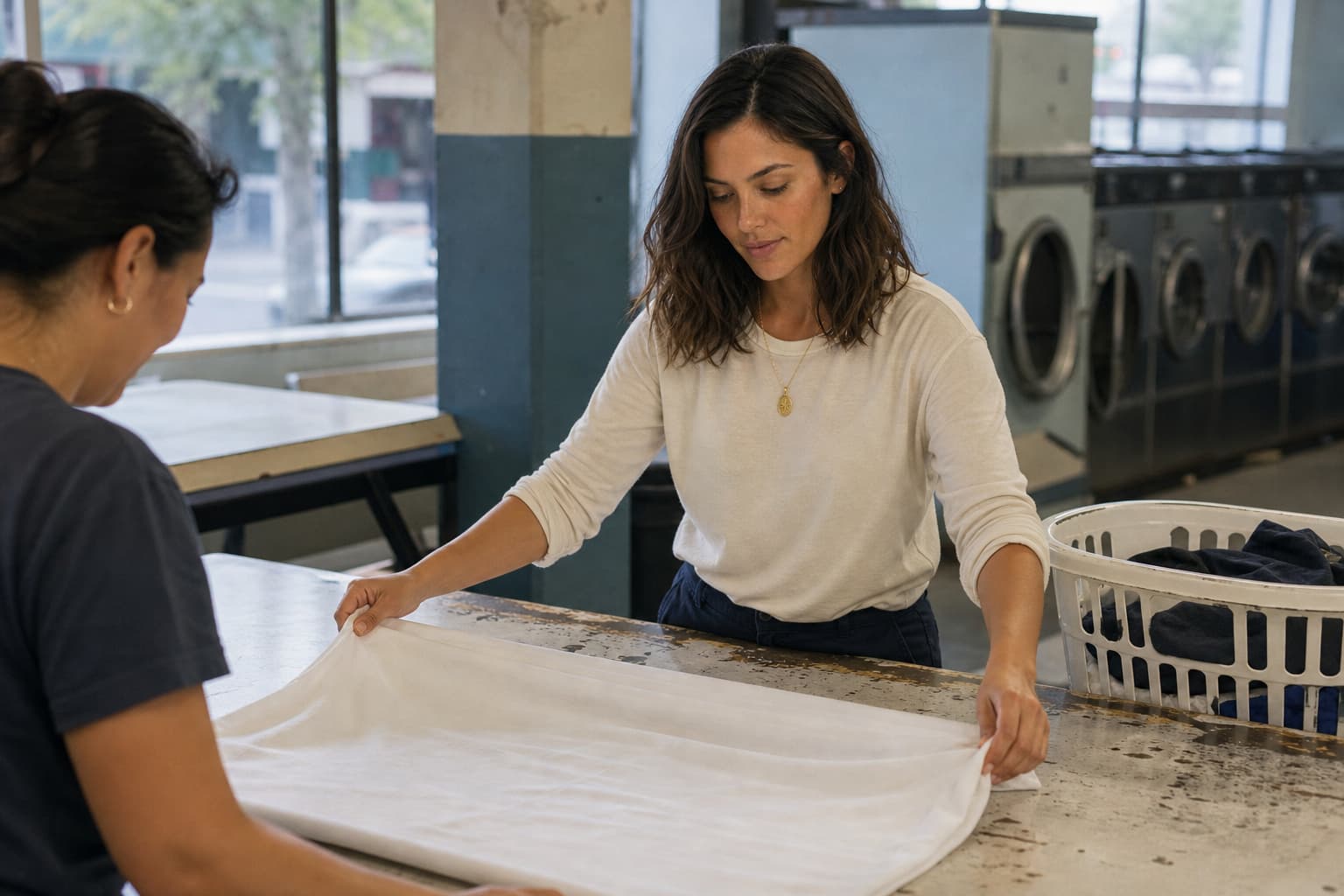
On Monday evening, I pulled a sheet from the dryer and lost one of its corners almost immediately. It was somewhere inside the rest of the sheet, which had twisted itself into a warm white rope. I stood beside the folding table at an unnamed laundromat near my apartment, holding what looked like a substantial failure of geometry. My other laundry waited in the basket. The socks, at least, had remained within their area of expertise.
I had spent the afternoon at my laptop, making a short presentation shorter. By six, the apartment felt close, and the laundry bag beside the bedroom door had become difficult to pass without acknowledging. I carried it down three flights with the detergent balanced on top. Outside, I could feel the cooler air through my cotton shirt. I had left my phone in the bottom of my tote, where it could continue receiving revisions without my immediate participation.
There were only a few people inside. A man sat facing a washer with his arms crossed; someone near the door was pairing small socks. The dryers turned behind round windows, lifting a sleeve and dropping it, lifting it again. I watched my own things for a while. There is something faintly exposing about seeing your pillowcases perform in public, especially when everyone else appears to have brought more sensible colors.
The far corners
Once the dryer stopped, I folded the towels first. They were pleasantly straightforward: edges, halves, a little pressure from the palm. The sheet was another matter. I found two corners, spread my arms, and discovered that the lower edge was dragging against the table leg. When I raised it, the middle slid down. I tried gathering the excess over one shoulder. This gave me the appearance of someone about to address a very small senate.
A woman at the other end of the table looked up from a pile of dark T-shirts. She asked whether I wanted her to take the far corners. I said, “Oh, I can manage,” with the bright little smile I use for inconveniences that have already become obvious. Then the sheet slipped again. She waited, hands resting on her own laundry. There was no reason for either of us to pretend that my method was approaching a conclusion.
“Actually, yes. Thank you,” I said. I passed her two corners and stepped back. Between us, the sheet opened into a broad rectangle, still warm enough that I could feel it through my fingertips. We drew our hands together, found the edges, and made the first fold. She lifted her side slightly so it cleared the table. I followed. The whole operation took less time than my refusal had.
The whole operation took less time than my refusal had.
I have folded larger cloths with other people. In Charleston, working beside someone at a long table, I knew when to lift and when to let the fabric settle. There was a practical pleasure in getting the motion right without much discussion. Here I hesitated before the second fold, uncertain whether to come toward her or bring my corners to the center. She moved first. I adjusted. We finished with a flat bundle that would fit in the basket instead of occupying it like a second tenant.
I thanked her again and looked at her pile of shirts, ready to offer my services. She had already returned to them. One sleeve disappeared neatly inside a fold, then the other. I could have asked whether she needed anything, but she was doing very well. I put the sheet away. For a moment I felt oddly idle, as though we had completed a transaction while leaving my part of it unpaid.
That feeling stayed with me while I paired my socks. At work, help tends to arrive with a task attached: another person takes one piece, I take another, and we know what each has contributed. I find that arrangement reassuring. A stranger holding two corners had given me nothing to organize afterward. She had seen an awkward thing happening within reach and briefly lent it her hands. I wondered how many times I had made a similar offer and then forgotten it before leaving the room.
We finished our separate piles without further conversation. I did not learn her name or explain why I had been so determined to fold a sheet alone. That would have been an ambitious use of the laundry table. When she lifted her bag, I shifted my basket out of the way. She nodded and left. I stayed to check the dryer once more, finding a single sock pressed against the metal at the back.
The bag felt heavier on the walk home, though of course it was drier. Upstairs, I put the sheet on the bed rather than in the cupboard. Its warmth had nearly gone. I shook it open, found that the folds had left a clear cross through the middle, and tucked one side beneath the mattress. Across the bed, the other two corners waited. I walked around to them.