Priya Wins on Points
A Saturday card game at my Cobble Hill kitchen table brings out an unexpectedly competitive evening with Priya.
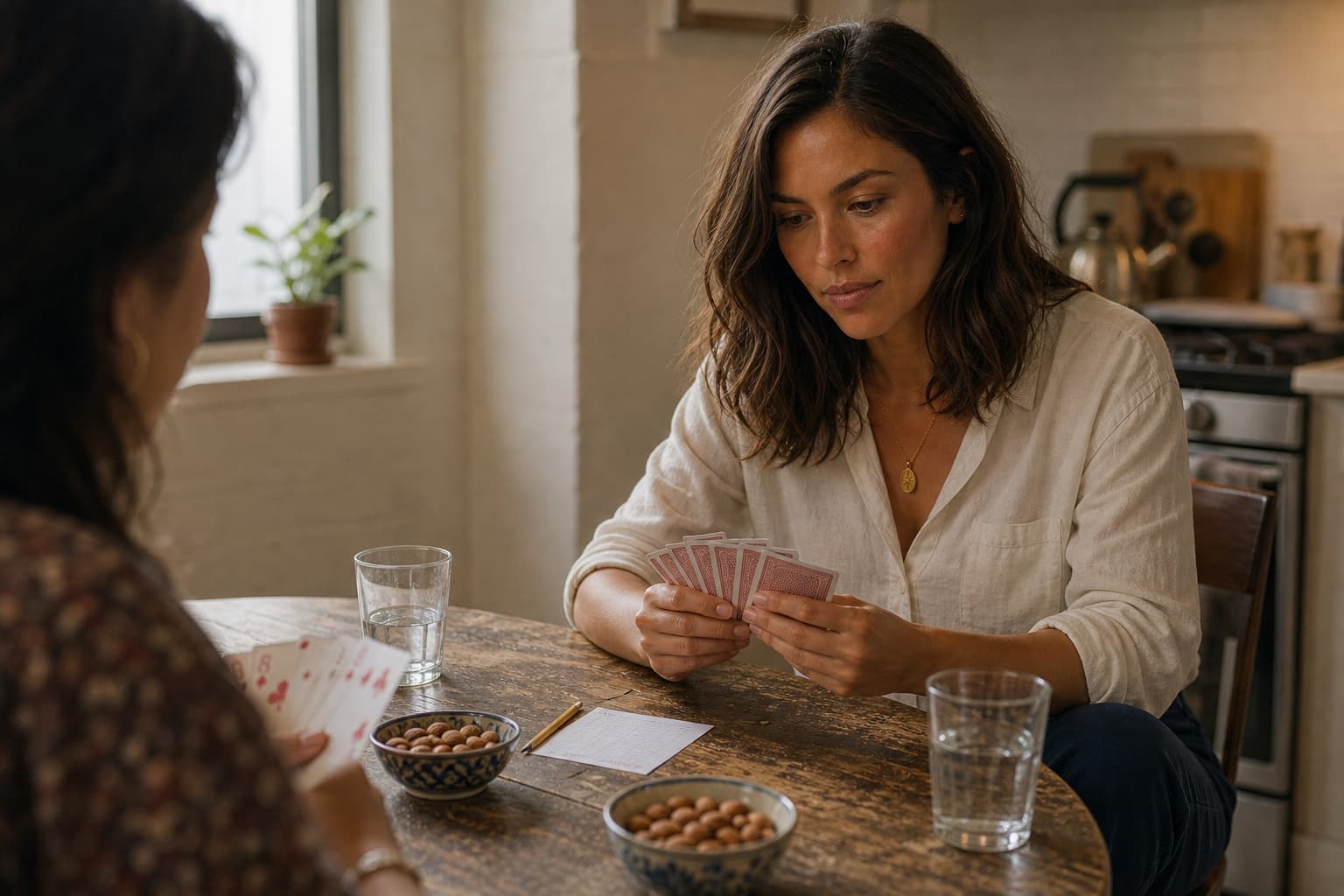
On Saturday evening, Priya put down a card and reached for the pencil before I had finished counting. We were at my kitchen table, playing a version of rummy whose rules we had agreed on twenty minutes earlier and were already discussing with the gravity of a disputed border. I moved her hand away from the scrap of paper. There were points to establish. She looked delighted.
The cards had been in a drawer beneath spare batteries and a ribbon I had apparently considered too useful to throw away. I found them while looking for a pen after supper. Their box was softened at the corners, and one red king had a small bend across his forehead. Priya asked whether I knew any games. I said I knew rummy, then added that I hadn't played in a while. This was accurate, although it also provided a convenient explanation for anything that might follow.
We cleared the plates and left our water glasses on the table. I brought out two small bowls of salted almonds, one for each of us, because a shared bowl beside a hand of cards seemed likely to cause difficulties. Priya said this was an impressive degree of infrastructure. Then she took an almond from my bowl. The evening had scarcely begun, and already there were questions of jurisdiction.
We played the first hand face up for a few turns, reminding ourselves how the game worked. I remembered sequences more readily than scoring. Priya remembered scoring and had opinions about sequences. We settled on a simple set of rules and wrote the disputed parts at the top of the paper. I liked having them there. There was something restful about a disagreement with an answer we could both point to.
A seven changes hands
Once we turned our cards toward ourselves, the table changed. Priya held hers in a loose fan and watched what I discarded. I arranged mine by suit, then by number, then back again, revealing an enormous amount of activity without necessarily conveying intelligence. The bent king kept appearing in my hand. I began to feel that I had inherited responsibility for him.
At work, I spend a good deal of time making decisions sound collaborative. This is generally useful. A roomful of people cannot all be allowed to believe that the last person who spoke has won. At my own table, I heard myself doing something similar: praising a good play, explaining the possibilities, making a small ceremony of fairness. Priya interrupted to ask whether I was going to discard anything before Sunday.
I put down a seven. She took it immediately and laid out the cards that finished the hand. I looked at the seven, now comfortably situated among its new associates. I had been holding it for several turns. Letting it go had seemed sensible until it became useful to someone else, at which point I developed a detailed retrospective understanding of its value.
“You wanted that,” I said. “Yes,” she said. “That's why I picked it up.” She added the score while I counted what remained in my hand. There was no diplomatic task concealed in the exchange. She had played better, and I was annoyed in a small, clean way that made me want to shuffle. I asked for another hand before she had put the pencil down.
I hadn't expected to enjoy wanting to win quite so openly. I can be competitive about work, but there the desire travels under more respectable names: standards, preparation, doing the thing properly. Losing at cards offered fewer opportunities for dignified translation. I wanted fewer points beside my name and more beside hers. She could see this, and it appeared to improve her evening.
She could see this, and it appeared to improve her evening.
On the next hand, I stopped explaining my decisions. I watched the cards she passed over and tried to remember what she had kept. Once, I reached for the almonds and changed my mind because I needed the hand to count. Priya noticed. She pushed my bowl closer without comment. It was a generous gesture from a woman who was otherwise making no effort to accommodate me.
I won that hand. I would like to report that I received the result with the modesty I encourage in other people. In fact, I turned the paper toward her so she could inspect the arithmetic. She inspected it, corrected a sum in my favor, and said I was welcome. I laughed hard enough to scatter the cards I had been gathering. One slid beneath the table, where I found it against the leg of her chair.
We played until the scrap of paper was nearly full. Priya won overall, by a margin small enough to encourage a recount and large enough to survive it. At the door, she asked whether I wanted to keep the score. I said I did. After she left, I put the cards back in their battered box and tucked the paper beneath them. The king's bent corner caught on the flap. I eased him inside with my thumbnail, then opened the drawer and moved the batteries to make room.